
AHEAD OF THE MARKET
What art teaches us about value, time and the limits of price.
By Amrita Sethi · 7 min read
There is a question I keep returning to:
What actually creates value in art?
Not price.
Value.
The distinction matters because the two are so often confused.
A work can be expensive and historically irrelevant. Another can be culturally important long before anyone knows how to price it.
Somewhere between those two conditions — between what something costs and what it comes to mean — much of art history is made.
I was reminded of this recently during a conversation with Hala Khayat at Art Dubai.
Hala has spent more than two decades inside the art world, watching artists, institutions, collectors and markets evolve over long periods of time. I had made an offhand comment about the relative simplicity of finance — that numbers, for all their complexity, at least tell you where you stand.
Her response was more interesting.
Perhaps, she suggested, the real difference is time.
Markets move quickly. Artistic careers often do not.
And then she said something that stayed with me:
sometimes an artist is simply ahead of the market.
At first, that can sound like reassurance.
But the more I thought about it, the more I realised it is actually a much larger observation about how value is created.
Markets prefer what they can recognise
Markets are extraordinarily sophisticated mechanisms for establishing price.
They absorb information, compare assets, establish benchmarks and turn millions of individual decisions into a number.
But markets are also, in an important sense, retrospective.
They are very good at valuing things once the category exists.
Once the vocabulary is understood.
Once there are precedents.
Once there are comparable transactions.
Once enough people agree that something matters.
Art often works in precisely the opposite direction.
Artists produce before consensus.
They experiment before there is vocabulary.
They sometimes create forms before institutions know where to place them, collectors know how to value them, or audiences know how to interpret them.
The artist is not simply producing within culture.
At times, the artist is helping culture develop the language with which it will later understand itself.
That is a very different economic proposition.
The problem with being early
We celebrate being early in almost every other area of innovation.
Venture capital is built around it.
Investors actively seek technologies that may seem strange, unnecessary or premature today but could become foundational tomorrow.
We praise founders who see a shift before everybody else.
We reward investors for recognising a market before it becomes obvious.
Yet in culture, being early is often indistinguishable from being wrong.
At least for a while.
This is partly because cultural innovation does not always arrive with an obvious commercial infrastructure around it.
Photography spent years fighting for recognition as art rather than mechanical reproduction.
Video art challenged ideas of what an artwork could physically be.
Digital art existed for decades before much of the traditional art market developed meaningful mechanisms for collecting, displaying and valuing it.
Today, artificial intelligence is forcing another confrontation.
What constitutes authorship?
Where does intention reside?
What is original when a machine can generate infinite variation?
Does labour confer value?
Does scarcity?
Does concept?
Does provenance?
Or does the definition of artistic value change when the means of production change?
These are not simply technological questions.
They are cultural questions.
And they generally appear before the market has decided what the answers are worth.
Price is a signal, not a verdict
None of this is an argument that sales do not matter.
They do.
Collectors matter.
Galleries matter.
Auction results matter.
Institutional acquisitions matter.
Artists, after all, exist inside an economy as much as anyone else.
But price is one signal among many.
It is not a final verdict on cultural relevance.
An artistic practice accumulates value in ways that are often invisible at first.
Through the development of a visual or conceptual language.
Through repetition.
Through risk.
Through an archive.
Through curatorial attention.
Through the relationship between one work and the next.
Through critical writing.
Through museum exhibitions.
Through collectors who continue to hold the work.
Through ideas that start influencing other ideas.
And perhaps most importantly, through time.
This is why an artistic career cannot be read like a quarterly report.
There is no clean line from production to revenue to validation.
The inputs and the outputs are separated by years, sometimes decades.
The market may eventually recognise what was already present in the work.
Or it may not.
That uncertainty is part of the structure.
Art has its own form of compounding
Finance has taught us to understand compounding mathematically.
Capital generates returns.
Returns are reinvested.
Time magnifies the effect.
Culture compounds differently.
An artist creates a work.
The work becomes part of a body of work.
The body of work creates a language.
The language develops context.
The context builds recognition.
Recognition creates memory.
And memory, eventually, can create significance.
None of those stages is guaranteed.
And they rarely happen neatly.
But viewed across a long enough period, artistic careers often reveal a form of compounding that is far more complex than sales alone.
Ideas compound.
Relationships compound.
Reputation compounds.
Institutional memory compounds.
The archive compounds.
And sometimes, eventually, the market does too.
Who decides what matters?
This raises another, more uncomfortable question.
Who actually decides what has value in art?
Collectors?
Museums?
Curators?
Galleries?
Critics?
Auction houses?
Artists themselves?
History?
The answer is all of them — but never at exactly the same time.
Cultural value is negotiated.
It emerges from a network of institutions, ideas, people, money and memory.
And because those systems move at different speeds, there can be long periods where price and significance diverge.
An artist can be commercially successful without ultimately becoming culturally important.
Another can remain relatively overlooked for years before their contribution becomes visible in retrospect.
We tend to look at established artists as though their trajectory was inevitable.
It rarely was.
What looks obvious in hindsight often felt deeply uncertain while it was being made.
The danger of constant measurement
Perhaps one of the unintended consequences of living in an increasingly quantified world is that we expect everything to give us immediate feedback.
Views.
Followers.
Revenue.
Engagement.
Valuations.
Growth.
Returns.
Dashboards have trained us to believe that if something matters, it should be measurable now.
But some of the most important forms of value do not behave that way.
An idea can be significant before it is popular.
A work can be influential before it is expensive.
A person can be building something important before anybody has created the metric capable of recognising it.
This is uncomfortable because humans like feedback.
Artists are no exception.
We want to know if the work is good.
If the exhibition mattered.
If somebody understood it.
If somebody wants to buy it.
If the years spent developing an idea are leading somewhere.
But perhaps the demand for constant validation is fundamentally incompatible with the timescale on which meaningful culture is sometimes created.
Capital and culture run on different clocks
I have spent much of my life between finance, technology and art.
Those worlds appear very different.
But they are all, ultimately, systems for deciding what we believe has value.
Finance expresses value through price.
Technology often expresses it through scale.
Culture expresses it through meaning.
The interesting territory is where those systems overlap — and where they disagree.
Because money can accelerate culture.
Technology can distribute it.
Institutions can legitimise it.
But none of them can fully determine what history will ultimately remember.
That part remains unpredictable.
And perhaps that is why art remains so compelling.
Finance asks:
What is something worth now?
Art asks a more difficult question:
What might this come to mean?
The first can often be answered with a number.
The second usually requires time.
And sometimes, the market arrives late.
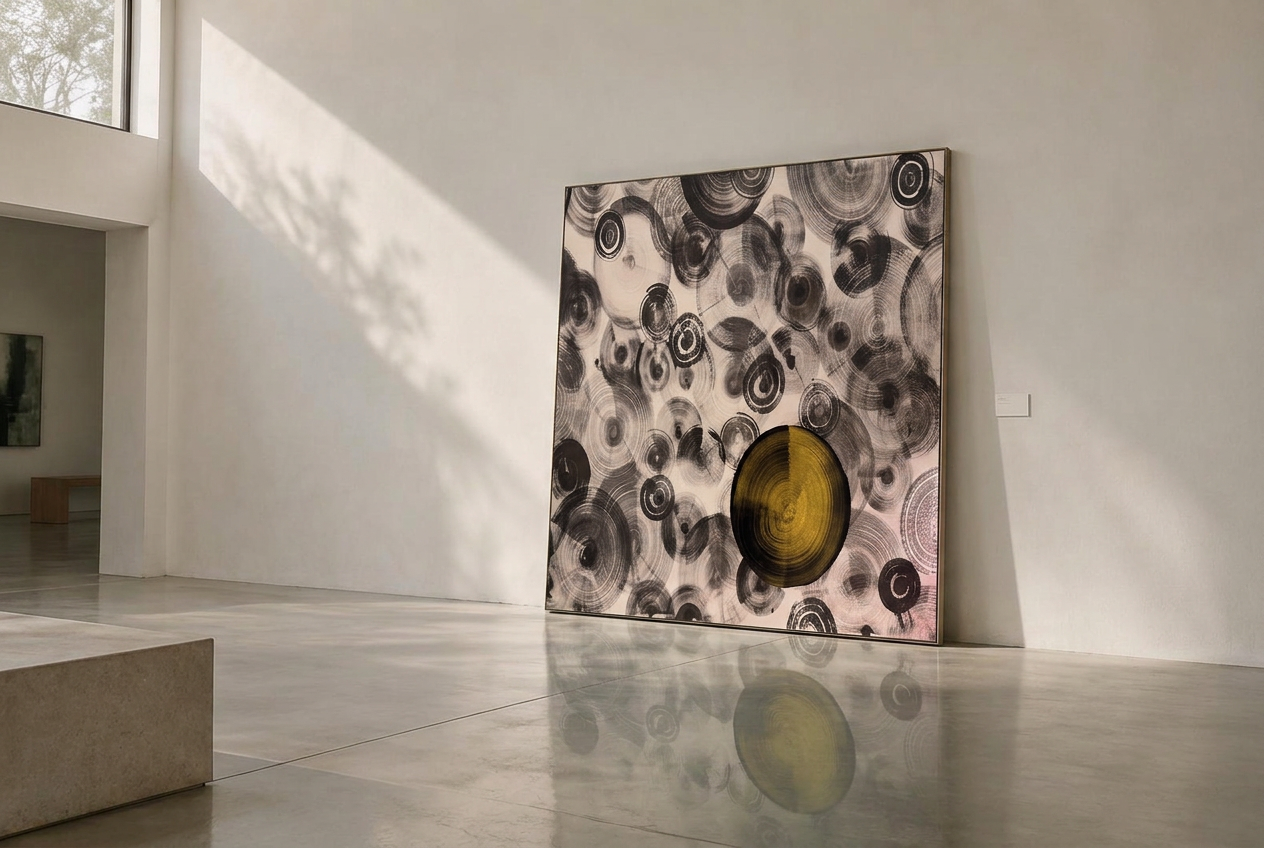
Amrita Sethi is the founder of Capital to Culture and an artist. The painting pictured, Anchor Field XX, is her own — amritasethi.com
Explore more perspectives →